
Which university should I apply to? Quiz apps promise a three-minute answer. We compared the five worth your time, and then asked the ruder question underneath: how often do the university acceptance rates behind their answers actually exist?
- UniMatch: ten questions on GPA, scores, budget, and country preference, then a ranked shortlist. Full version $4.99 one-time per search. The quiz takes three minutes; the shortlist has no sponsors.
- Yocket: quiz plus community data from thousands of Indian applicants. Free, with a counselling upsell after the results.
- Studee: short UK quiz, clean matches, unusually honest about UK entry rates. Free, partner-funded.
- Niche: US-only quiz with grades and vibe questions, backed by student reviews. Ad-supported.
- IDP Live: a quiz that ends in a counsellor call. Free, commission-driven.
A quiz is only as good as its questions. If it never asks your budget, it will recommend schools you cannot afford. If it never asks your grades, the rate it shows you is decoration.
The data behind the answers, counted by country
Our dataset holds 500 universities. Only 148 publish an acceptance rate, and the coverage is wildly uneven by country. Brazil and Russia publish for every university we hold, 18 of 18 and 12 of 12. Thailand and Malaysia publish for 7 of 12 each. The United Kingdom manages 12 of 45, the United States 53 of 250, and Australia 1 of 30. China, Germany, and the Netherlands publish nothing at all in our data: 0 of 25, 0 of 18, and 0 of 10.
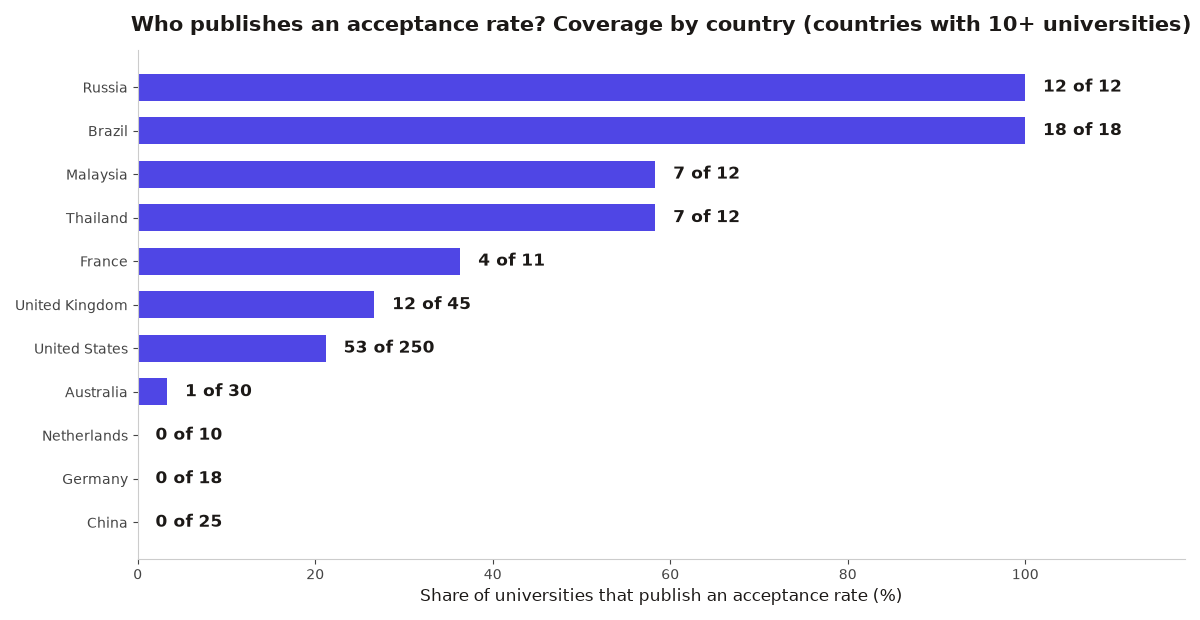
Read that chart the way a quiz cannot. When an app confidently matches you with a German university, it is not working from a published German acceptance rate, because in our data there are none. It is extrapolating from rankings, reputation, and other students' outcomes. Sometimes that is useful. It is never the same as a rate.

The pattern is not random. Countries with centralised, public admissions systems tend to publish; countries where admissions are decentralised to each university tend not to, and the United States, where publishing is voluntary, lands in the middle at about one university in five. A quiz that covers many countries is therefore not one quiz. It is several different instruments wearing the same interface, and its confidence should vary by country even when its design does not.
There is a useful test you can run on any quiz in two minutes. Ask it for matches in a country where the published data is strong, say Brazil, and then for matches in a country where it is absent, say Germany. If the German answers arrive with the same confidence, the same formatting, and the same number of decimal places as the Brazilian ones, you are looking at a tool that does not know what it does not know. The results page should change character when the data runs out. When it does not, your scepticism should rise to fill the gap.
How to use a quiz honestly
Answer honestly, especially on money; a quiz fed a fantasy budget returns a fantasy list. Then treat the output as a draft. Check each suggested university against its published rate where one exists, and where none exists, ask what the app used instead. Our free vs paid match apps comparison shows what the paid tier actually buys, and our counted analysis of published acceptance rates shows the bands the honest apps work from.
Our own Balanced Shortlist Builder skips the quiz format and goes straight to the arithmetic: GPA and budget in, reach, match, and safety bands out, drawn only from the 500 universities we hold data on. Where the data runs out, it says so. That silence is the most honest feature a matching tool can have.
None of this means quizzes are useless. A good quiz is an interview, not an oracle: it forces you to state a budget, a grade profile, and a country preference, possibly for the first time, and that statement alone improves every conversation you have afterwards, with counsellors, with parents, and with the universities themselves. Just do not mistake the tidiness of the output for the solidity of the data underneath it.
Sources: Common Data Set, College Navigator