
A college matchmaker tool with a budget attached is the only kind worth downloading. Check these six things before you install anything:
- Real budget math: tuition plus living costs per year, not tuition alone. A $20,000 tuition in Boston costs more all-in than $30,000 in Dresden.
- Multi-country coverage: US, UK, Europe, and Australia in one shortlist. Single-country apps waste your time if you are still deciding.
- GPA and score inputs: if the app never asks for your numbers, its matches are horoscopes.
- Who pays: free apps earn from university commissions or counselling upsells. One-time pricing means you are the customer.
- Deadline tracking: a shortlist without dates is a wish list. Push reminders beat memory.
- Offline access: airport wifi is not a planning tool. Checklists should work without signal.
Install two, keep one. Run the same profile through both and compare the shortlists side by side. The honest one shows an acceptance rate next to the yearly cost, because a match without a price tag is just trivia.
The budget data problem, counted
Here is what the six checks cannot fix: the underlying budget data barely exists. In our own dataset of 500 universities, only 40 publish an international tuition figure at all. Acceptance rates are published by 148, average GPAs by 58, and tuition, the number your family actually plans around, by just 40. Any matchmaker tool you download is working from a similarly thin slice, whether it admits it or not.
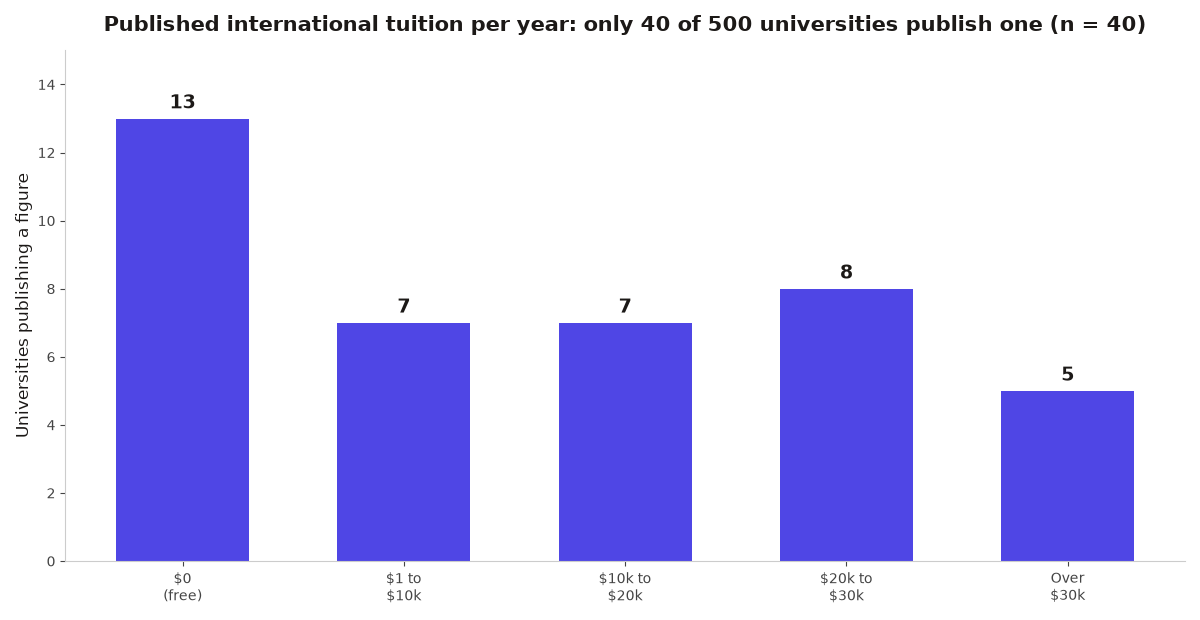
Of those 40, the largest group, 13, charge nothing at all: they are the Brazilian federal and state universities in our data, free by law. Seven sit at $5,000 a year, seven between $10,000 and $20,000, eight between $20,000 and $30,000, and five above $30,000, up to $65,000. The spread is the lesson. A budget tool that assumes a typical price is inventing it; the real distribution runs from free to five figures with no honest middle.

There is a second lesson in the bands. Free and cheap options cluster in specific systems, not randomly: public universities in Brazil charge no tuition, and the $5,000 band is a handful of public institutions elsewhere. If your budget is under $10,000 a year, your realistic map is short and specific, and a good tool should show you that map honestly instead of padding it with guesses.
What a budget-first shortlist looks like
Put the bands to work and a budget-first shortlist builds itself in layers. Under $10,000 a year, the published map is the 13 free Brazilian universities plus the $5,000 band, and your real work is language and admissions, not money. Between $10,000 and $30,000, the published options widen to include Ireland, Singapore, and Hong Kong names from our overlap data. Above $30,000, price stops filtering and the acceptance rate becomes the filter that matters. A tool that shows you these layers honestly is doing its job; a tool that shows you 200 undifferentiated matches is hiding the shape of the market.
That is also why budget tools disagree with each other so often. Two apps fed the same profile are not working from the same 40 published prices; they are working from different guesses about the other 460. When two shortlists disagree, ask each tool which of its prices are published and which are modelled. The answers will explain the disagreement.
What to do with a thin dataset
Use the tool for structure, not for gospel. Let it sort universities into reach, match, and safety against your GPA, then verify the price of every survivor on the university's own fees page before it goes on your final list. Where a price is missing, treat the match as provisional. Our roundup of the cheapest universities for international students starts from published prices only, and our Android shortlisting guide applies the same discipline on mobile.
UniMatch is my study abroad counselling pick in this category: it pairs the match with a budget view, and the full version runs $4.99 one-time per search, which keeps you the customer. For a free second opinion built on the dataset above, run your numbers through our Balanced Shortlist Builder. It will show you reach, match, and safety picks from the 500, and it will not pretend to know a tuition figure that was never published.
Sources: Common Data Set, College Navigator