
Best value universities abroad are where tuition and acceptance rate meet. A cheap university you cannot get into is not value, and a generous acceptance rate at a price you cannot pay is not either. Value needs both numbers at once, which is why this article is shorter on names than you might expect: in our dataset of 500 universities, only 20 publish both a tuition figure and a university admission rate.
Start with the coverage. An acceptance rate is published by 148 of the 500. An international tuition figure is published by 40. The overlap, the only ground where a value judgement can be computed rather than guessed, is 20 universities. Everything else in the value debate is one number and a hope.
The 20 universities where price meets rate
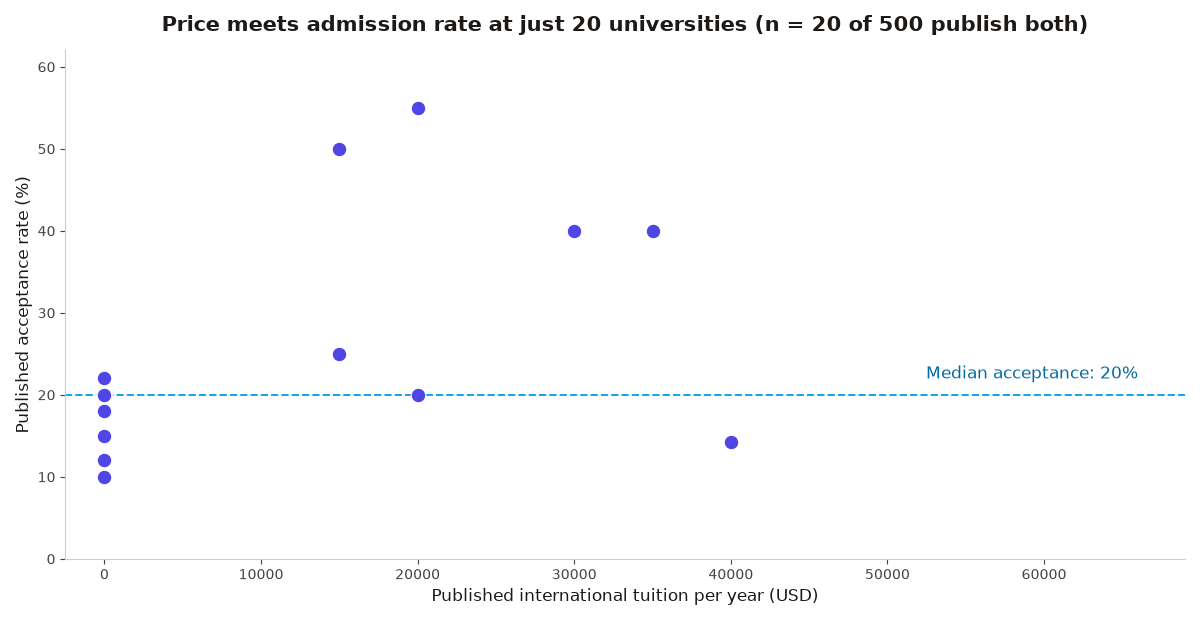
The pattern in those 20 is striking. Thirteen cluster at zero tuition: the Brazilian federal and state universities, free by law, with published acceptance rates between 10 and 22 percent. The University of São Paulo admits about 10 percent at no tuition; Campinas about 12 percent, also free. At the other end, Imperial College London pairs $40,000 with a 14.3 percent rate, University College London $35,000 with 40 percent, and Edinburgh $30,000 with 40 percent. In between sit University College Cork at $20,000 and 55 percent, and the Singapore Institute of Technology at $15,000 and 50 percent. The median acceptance rate across the 20 is 20 percent.
Two lessons follow. First, free does not mean easy: the zero-tuition cluster is selective, because price is not the only rationing device. Second, price does not buy certainty in any simple way: the most expensive name on the chart is also one of the hardest to enter, while two of the most generous rates sit at mid-range prices. Value lives in the exceptions, and you only find them where both numbers are published.
The band that publishes nothing

The strangest cell in the data is the $5,000 band. Seven universities publish a tuition of $5,000 a year, a genuinely affordable price, and not one of them publishes an acceptance rate. They may be bargains or they may be lotteries; from published data, nobody can say. When a listicle names a cheap university without a rate, it is standing on exactly this kind of gap.
Building a value shortlist from thin data
Work in three passes. First, set your ceiling: the total yearly cost your family can carry, tuition plus living costs, for the full length of the degree. Second, filter the published-price universities against that ceiling and read their rates where they exist; a 50 percent rate at $15,000 is a plan, while a 12 percent rate at the same price is a lottery ticket, and a healthy list holds more plans than tickets. Third, for universities you love that publish neither figure, go to the primary sources: the fees page, the admissions statistics release, the Common Data Set for US schools. The absence of a number in our dataset is a prompt to look, not a verdict.
Run the same exercise on living costs and the picture thins further, because almost nobody publishes a comparable all-in figure at all. That is why every value claim in this article is built on tuition and rates alone, the two numbers that exist, and why your own budget for rent and food deserves the same scepticism you now apply to league tables.
And keep the time dimension in view. A three-year degree at a higher yearly price can cost less overall than a four-year degree at a lower one, and a free degree in a high-cost city is not free to live through. Value is a total, not a sticker.
UniMatch handles the counselling side of this well and costs $4.99 one-time per search. Our own approach is narrower and more stubborn: the Balanced Shortlist Builder sorts the 500 by your GPA and budget, and our guide to the cheapest universities for international students works only from published prices. Build your value list from the overlap, verify each price on the university's own site, and let the universities that publish neither number make their own case to you.
Sources: Common Data Set, College Navigator